“Unboxed doesn’t mean ready for use.”
Every new fire extinguisher must be commissioned on-site before it’s legally compliant. It’s one of the most misunderstood parts of fire safety – and one of the easiest to get wrong.
Even if an extinguisher arrives brand new and sealed, it can’t legally be used until it’s been commissioned by a competent person. This guide breaks down what commissioning involves, who can do it, and why it matters for compliance under BS 5306-3:2024.
BS 5306-3 was updated in 2024 to include clearer definitions of competence, record-keeping, and the link between commissioning and ongoing maintenance.
Commissioning also supports your legal duties under the Regulatory Reform (Fire Safety) Order 2005 – specifically Articles 17 and 38, which require all firefighting equipment to be kept in efficient working order and maintained by competent persons.
Quick Answer: Do new fire extinguishers need to be commissioned?
Yes. New fire extinguishers need to be commissioned on-site by a competent person before they are put into service. A brand new extinguisher may still have been damaged, discharged, incorrectly assembled or supplied with the wrong signage during transport, so commissioning confirms it is safe, suitable, correctly labelled and ready for use.
Key Takeaways – Fire Extinguisher Commissioning
- Commissioning is mandatory under BS 5306-3 – it confirms your extinguishers are safe, pressurised, and suitable for the risks on-site.
- It must be completed on the premises by a competent or BAFE-registered engineer.
- The process checks for transit damage, correct pressure, assembly, and clear labelling.
- Buying pre-commissioned extinguishers is non-compliant and can invalidate insurance or audit results.
Jump to:
Who Can Commission Extinguishers?
What Happens During Commissioning?
Pre-Commissioned Units: The Hidden Risk
Commissioning vs Servicing vs Installation
Does Installation Include Commissioning?
Certificates & Audit Records
Book BS 5306-Compliant Commissioning
FAQs
Resources
What Is Fire Extinguisher Commissioning?
Commissioning is the initial inspection and preparation of new fire extinguishers, carried out by a qualified engineer before they’re installed for use.
Under BS 5306-3:2024 (Clause 5.1), every extinguisher must be commissioned on-site – not at the supplier’s warehouse – because transport can cause damage, leaks, or loss of pressure that aren’t visible until checked.
The process ensures:
- The extinguisher is undamaged and correctly assembled.
- It’s the right type and rating for the fire risks in that area.
- The weight and pressure match manufacturer specifications.
- All safety pins, seals, and O-rings are fitted correctly.
- It’s labelled and ready for installation.
Commissioning turns a boxed unit into a compliant life-safety device.
Learn more about our Fire Extinguisher Commissioning & Decommissioning service.
Who Can Commission Fire Extinguishers?
Only a competent person can commission extinguishers. In practice, that means a trained engineer holding BAFE SP101 registration or equivalent qualification.
They must understand:
- Fire classes and extinguisher types
- BS 5306-3 and BS 5306-8 standards
- How to inspect, weigh, and assemble each model correctly
- Record-keeping and certification requirements
Employers or site staff can perform basic visual checks, but commissioning must be done by a qualified engineer – not an in-house maintenance team.
Need ongoing support? Explore our Fire Extinguisher Servicing & Maintenance options.
What Happens During Commissioning?
A commissioning visit typically includes the following steps:
- Unpack and inspect each extinguisher for dents, rust, scratches, or loose components.
- Check labels and markings against manufacturer and BS 5306 requirements.
- Weigh or gauge the extinguisher to confirm it’s fully charged.
- Assemble discharge horns, hoses, and brackets; verify all seals and O-rings are intact.
- Check the pressure indicator or gauge where fitted, including whether the gauge is reading correctly and can be properly inspected before the extinguisher is installed. This should not be confused with discharging or operating the extinguisher to test it before use.
- Confirm suitability for the environment and specific fire risks (e.g. electrical, flammable liquids).
- Check that wall signage and identification labels match the extinguisher type and are visible at the point of installation (as required by BS 5306-8).
- Label and tag with commissioning date, engineer ID, and next inspection due date.
- Issue commissioning certificate for the site fire logbook.
Real Example: Why Brand New Still Needs Checking
We are often asked why a brand new fire extinguisher needs to be commissioned before use. This is a prime example.
During commissioning, we found a brand new extinguisher straight out of the box with no hole in the viewing window. This hole is used to test the gauge, and is generally covered with a gauge dot afterwards to stop dirt entering the gauge.
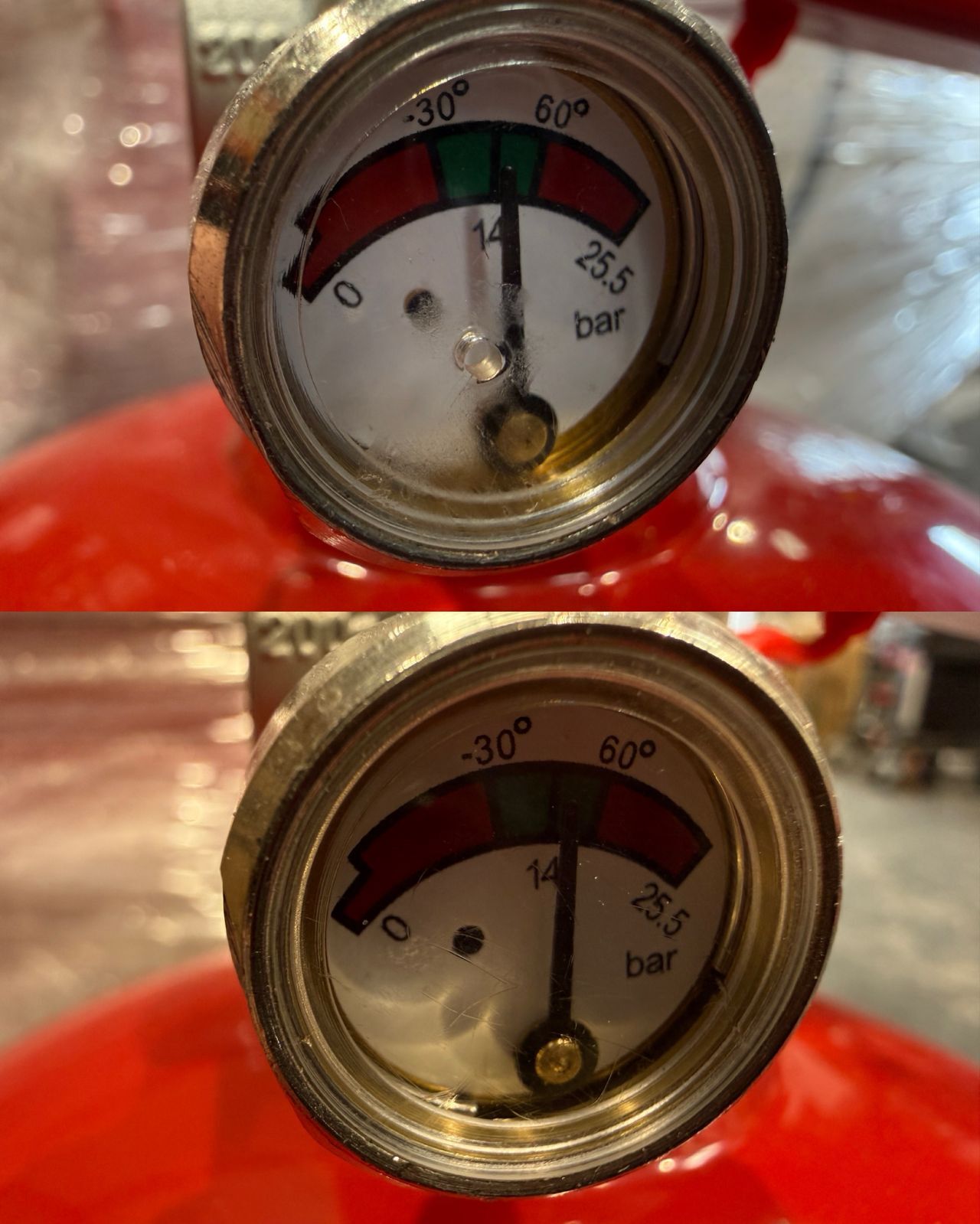
Without commissioning, this could easily have been missed. The extinguisher may have looked new, sealed and ready to hang on the wall, but it still needed proper checks before being put into service.
Commissioning is not just a quick visual look. It can include weighing the extinguisher to make sure it is within manufacturing tolerance, removing transport tags, pulling the pins, replacing anti-tamper tags and confirming the extinguisher is ready for use.
It is not a case of buying online, taking it out of the box and hanging it on a wall or stand.
The data captured during commissioning – such as serial numbers, pressure readings, and engineer ID – forms the baseline for every future service. Each annual inspection compares back to those original figures, providing complete traceability throughout the extinguisher’s lifespan.
Pre-Commissioned Units: The Hidden Risk
Pre-commissioned or “ready-to-use” extinguishers might look convenient, but they’re not compliant with BS 5306-3.
During transport, storage or even manufacture, faults can occur that are not obvious until a competent person carries out the commissioning process. For example, even small knocks or temperature changes can:
- Bend safety pins or handles
- Loosen valves and discharge hoses
- Cause pressure loss in CO₂ units
- Damage internal components not visible externally
A pre-commissioned label from a supplier doesn’t prove the extinguisher is safe or correctly positioned for your premises. It also leaves you open to audit failures, insurance invalidation, or worse – a failed extinguisher during an emergency.
Some in the industry jokingly call these the “red-tin bandits” of fire safety – selling shortcuts that put clients at risk.
Commissioning is especially critical on construction sites, industrial estates, and temporary fire points, where extinguishers are regularly relocated. Each move increases the risk of damage or pressure loss – so re-commissioning after relocation is often required to stay compliant.
Commissioning vs Servicing vs Installation
Most people use these terms interchangeably – but in compliance, the timing and purpose of each are completely different. Commissioning happens before an extinguisher is ever used, installation is about positioning it correctly, and servicing keeps it compliant year after year.
Here’s how they compare at a glance.
| Stage | When It Happens | What It Covers |
|---|---|---|
| Commissioning | On delivery & before use | Initial on-site inspection, pressure and weight checks, assembly, and labelling |
| Installation | Immediately after commissioning | Correct mounting height, signage, and positioning under BS 5306-8 |
| Servicing | Every 12 months | Annual inspection, partial discharge tests, and refills as needed |
Commissioning and servicing are governed by BS 5306-3, while installation and positioning fall under BS 5306-8:2012.
In short: commissioning ensures safety from day one – servicing keeps it that way.
Does Fire Extinguisher Installation Include Commissioning?
Fire extinguisher installation and commissioning are closely connected, but they are not the same process.
Commissioning confirms that the extinguisher itself is safe, correctly assembled, suitable for the risks present and ready to be placed into service. Installation covers where and how the extinguisher is positioned within the premises.
In practice, a competent engineer will normally commission the extinguisher immediately before installing it.
A compliant fire extinguisher installation should consider:
- Whether the extinguisher type and fire rating are suitable for the risks in that area.
- Whether the extinguisher is positioned where it can be reached quickly and safely.
- Whether an appropriate wall bracket, cabinet or freestanding fire point is required.
- Whether the correct identification signage is clearly visible.
- Whether access to the extinguisher is unobstructed.
- Whether the overall positioning follows the recommendations of BS 5306-8.
An extinguisher can pass its commissioning checks but still be installed incorrectly. Equally, an extinguisher may be mounted in a suitable position but remain non-compliant if it has not first been commissioned on-site.
For that reason, commissioning and installation are normally completed during the same visit, with the commissioning record confirming the extinguisher is ready for use and the installation assessment confirming it is correctly positioned.
Arrange on-site fire extinguisher commissioning and installation with Velocity Safety.
Certificates & Audit Records
A fire extinguisher commissioning certificate confirms that each extinguisher has been checked on-site by a competent person before being placed into service. This gives you evidence for fire risk assessments, insurance checks, internal audits and enforcing authority inspections.
Every extinguisher must have:
- A commissioning record with date, engineer name, and certificate reference.
- A maintenance label showing the next inspection date.
- Entry in the site’s fire safety logbook or digital asset register.
The commissioning certificate is produced after a competent person has inspected the extinguisher at the premises where it will be used. It records that the extinguisher has been checked, correctly prepared, found suitable for the location and placed into service in accordance with BS 5306-3.
This distinction is important because documentation supplied with a new extinguisher does not confirm that it has arrived without damage, retained the correct pressure or been installed in a suitable position.
What Should a Fire Extinguisher Commissioning Certificate Include?
The exact format may vary between providers, but the commissioning record should normally identify:
- The premises or site where commissioning was completed.
- The date of the commissioning visit.
- The extinguishers inspected and placed into service.
- The competent person or organisation completing the work.
- Any defects, replacements or corrective actions identified.
- The next inspection or maintenance date.
For estates or multi-site portfolios, Velocity Safety can create traceable audit records across all locations, supporting insurance and CQC or fire authority inspections.
Learn more about our Fire Extinguisher Surveys & Compliance Audits.
Final Takeaway
Every extinguisher starts life the same – it’s commissioning that makes it compliant.
One short visit from a qualified engineer gives you certification, peace of mind, and proof that your firefighting equipment meets BS 5306 and Fire Safety Order requirements.
Book Fire Extinguisher Commissioning & Compliance Support
Make sure every extinguisher on your site is safe, traceable, and audit-ready with on-site commissioning and installation in line with BS 5306-3:2024.
📞 Call: 01254 933 486
📩 Email: info@velocitysafety.co.uk
🌐 Or book online here
If you manage multiple premises or construction sites, an independent fire extinguisher compliance audit can verify coverage, records, and on-site documentation.
Frequently Asked Questions
We get asked the same questions on almost every site visit – from whether new extinguishers need commissioning, to who can legally sign them off. Here are the quick answers to keep your compliance on track and your extinguishers audit-ready.
Do new fire extinguishers need to be commissioned?
Yes. New fire extinguishers should be commissioned on-site by a competent person before they are placed into service. This confirms that each unit is undamaged, correctly assembled, properly labelled, suitable for the risks present and ready for use.
Does a brand new fire extinguisher need to be inspected?
Yes. A brand new fire extinguisher still needs an on-site inspection before use. Commissioning checks for transport damage, pressure loss, missing parts, incorrect labelling and whether the extinguisher is suitable for the location.
Why does a brand new fire extinguisher still need commissioning?
Because brand new does not always mean ready for use. We have seen new extinguishers arrive with issues that would not be spotted unless they were properly commissioned, including problems affecting gauge testing. Commissioning confirms the extinguisher is safe, correctly prepared, tagged and ready to be placed into service.
Are new fire extinguishers already certified?
A new extinguisher may come with manufacturer documentation or a declaration of conformity, but this is not the same as an on-site commissioning certificate. The extinguisher still needs to be checked, tagged and recorded by a competent person before it becomes compliant for use.
Can fire extinguishers be installed before commissioning?
No. Fire extinguishers should be commissioned before they are placed into service. In practice, commissioning and installation are normally completed during the same visit, with the engineer first confirming the extinguisher is safe before checking that it has been correctly positioned and signed in accordance with BS 5306-8.
Do new fire extinguishers come with tags?
New extinguishers may arrive with manufacturer labels or transport tags, but these are not the same as a commissioning and maintenance label. The relevant service label or tag is completed by the competent person after the extinguisher has been inspected and commissioned on-site.
Can I do it myself?
Commissioning should be completed by a competent person with the appropriate training, knowledge and understanding of BS 5306-3. Using a properly trained fire extinguisher engineer or a BAFE SP101-registered organisation provides stronger evidence that the work has been completed competently and correctly recorded.
How long does commissioning take?
The time required depends on the number and type of extinguishers, site access, installation requirements and the level of record-keeping involved. Small installations can often be completed during a short site visit, while larger or multi-site projects will naturally take longer.
Should you test a fire extinguisher before use?
No. You should not discharge a fire extinguisher simply to test it before placing it into service. During commissioning, a competent person checks its condition, weight, pressure indicator, seals, operating components and suitability without unnecessarily discharging the extinguisher.
Do CO₂ extinguishers need weighing?
Yes. Weight loss is the only reliable way to confirm the contents of a CO₂ extinguisher. Unlike stored-pressure extinguishers, a visual inspection alone cannot confirm whether a CO₂ extinguisher is fully charged.
What paperwork do I receive?
You should receive a commissioning certificate or commissioning record, an updated maintenance label attached to the extinguisher, and entries in the site’s fire safety logbook or asset register confirming that the extinguisher has been commissioned and placed into service.
Resources
- BS 5306-3:2024 – Commissioning and Maintenance of Portable Fire Extinguishers
- BS 5306-8:2012 – Selection and Positioning of Fire Extinguishers
- Regulatory Reform (Fire Safety) Order 2005
- HSE Guidance: Fire Safety in the Workplace
- BAFE SP101 Scheme: Competency of Portable Fire Extinguisher Organisations