“A tag on the outside doesn’t tell you what’s happening on the inside.”
Many businesses assume that if a fall arrest block has an inspection tag attached, it must be safe to use.
Unfortunately, that isn’t always the case.
For many fall arrest blocks and inertia reels, manufacturers specify periodic servicing in addition to routine inspections. Simply carrying out a visual examination and attaching a new inspection tag is not the same as completing a full manufacturer-approved service.
Quick Answer: Do fall arrest blocks need servicing or just inspection?
Many fall arrest blocks require both periodic inspection and manufacturer-specified servicing. These are separate activities. Where the manufacturer requires an internal service, the unit must be opened using the applicable procedure so that internal components can be examined, maintained and tested. An external inspection tag does not prove this work has taken place.
Key Takeaways – Fall Arrest Block Servicing
- An inspection is not the same as a service.
- Many manufacturers require periodic servicing as part of their maintenance instructions.
- A proper service involves opening the unit, inspecting internal components and replacing parts where required.
- Simply attaching a new inspection tag does not prove a service has taken place.
- EN 360 is a product standard—not a safe working load and should not be entered as the equipment’s SWL.
Jump to:
What’s the Difference Between an Inspection and a Service?
An inspection checks whether equipment appears safe and suitable for continued use.
A service goes much further.
Where required by the manufacturer, servicing involves opening the fall arrest block to inspect internal components that cannot be assessed during an external examination alone.
| Inspection | Service |
|---|---|
| External examination | Internal examination |
| Visual checks | Unit opened |
| Labels and markings checked | Critical components inspected |
| Functional checks | Cleaning, lubrication and component replacement where required |
| Inspection record completed | Service record completed |
Learn more about our Fall Arrest Block Servicing service.
A Real Example: EN 360 Entered as the Safe Working Load
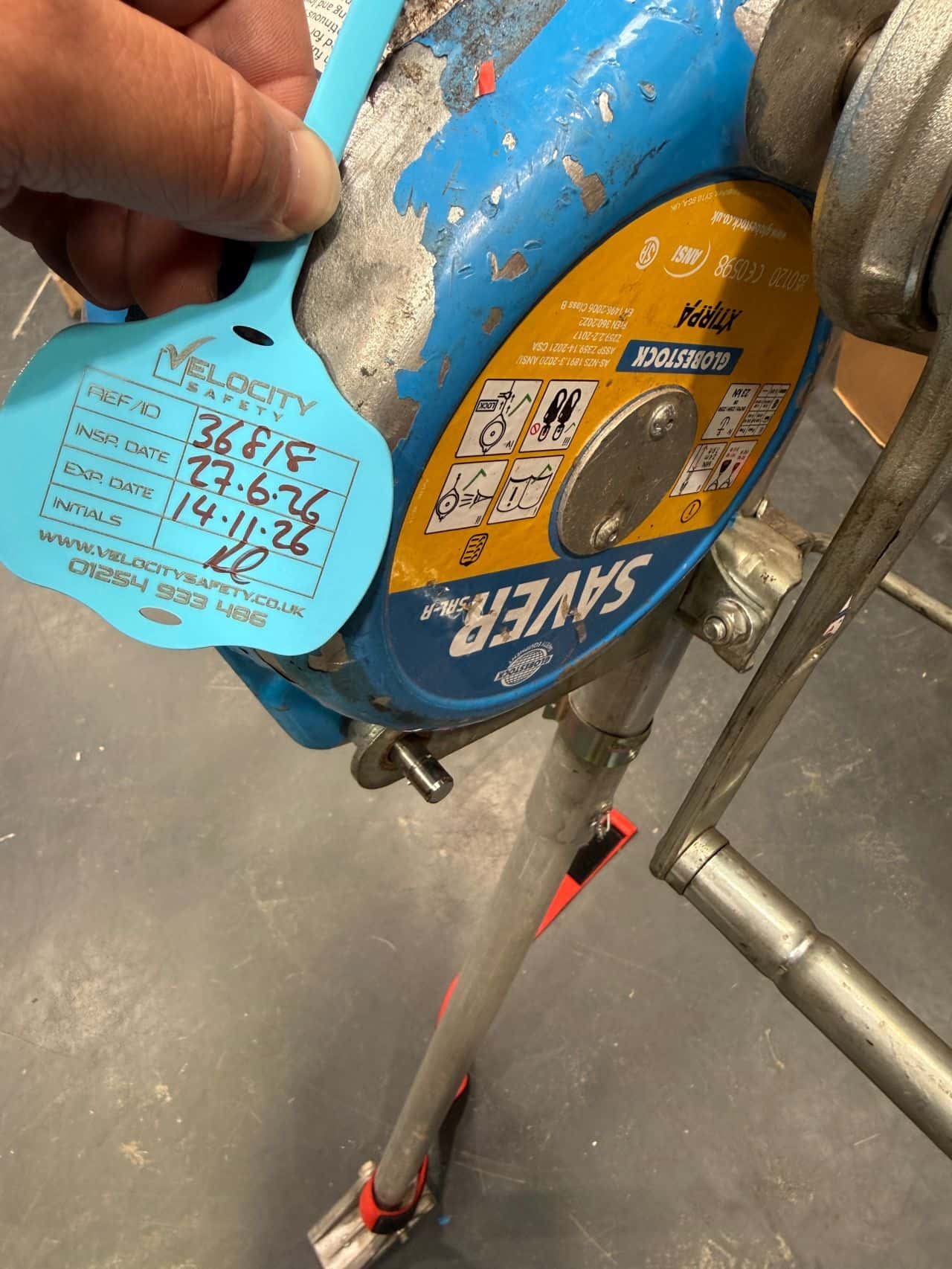
We recently encountered a fall arrest block carrying a lifting-equipment inspection tag with EN 360 written in the Safe Working Load field.
That information does not belong there.
EN 360 is the product standard for retractable-type fall arresters. It is not a safe working load.
EN 360 does not mean SWL
Writing EN 360 in an SWL field does not communicate a load capacity. It identifies a standard associated with the equipment—not the weight it can safely support or the conditions in which it can be used.
The incorrect entry also raised a more important question: what work had actually been completed before the tag was attached?
The tag alone did not confirm:
- Whether the make and model had been correctly identified
- Whether the manufacturer’s instructions had been checked
- Whether the required servicing was current
- Whether an internal mechanical examination had taken place
- Whether the provider was authorised to service that model
- Whether a separate service record was available
An inspection tag is only useful when it accurately describes the equipment and is supported by the correct inspection or servicing records.
It cannot turn an external examination into a manufacturer-specified internal service.
Where the manufacturer requires periodic servicing, the employer should verify the service date, provider and supporting documentation rather than relying on the presence of a tag.
What Happens During a Proper Fall Arrest Block Service?
Although servicing procedures vary between manufacturers, a proper service may include:
- Opening the unit.
- Inspecting internal braking mechanisms.
- Checking springs, pawls and ratchets.
- Cleaning internal contamination.
- Replacing worn components where required.
- Lubricating moving parts where specified.
- Reassembling and function testing the unit.
These are checks that simply cannot be completed without opening the equipment.
A Real Workshop Example
Recently we received several fall arrest blocks that had supposedly been serviced the previous year.
Once the units were opened, the internal markings still showed the original manufacturing date from 2022.
There was no evidence that the units had ever been opened for an internal examination.
That illustrates the difference between carrying out a proper manufacturer-specified service and simply attaching a new inspection tag.
Warning Signs a Fall Arrest Block Hasn’t Been Properly Serviced
Potential warning signs include:
- Only an external inspection label with no service record.
- Equipment that has never been opened despite manufacturer servicing requirements.
- Service prices that seem unrealistically low for the work involved.
- No approved servicing documentation.
Remember:
If the manufacturer specifies servicing, servicing isn’t optional.
Final Takeaway
Inspection and servicing are not interchangeable terms.
If your fall arrest block requires periodic servicing, simply carrying out an external inspection is unlikely to meet the manufacturer’s maintenance requirements.
Choosing an approved service provider helps ensure the equipment is properly examined both inside and out.
Book Fall Arrest Block Servicing
Velocity Safety provides professional fall arrest block servicing alongside PFPE inspections, helping businesses keep work at height equipment compliant throughout its working life.
📞 Call: 01254 933486
📩 Email: info@velocitysafety.co.uk
🌐 Or contact us online
Frequently Asked Questions
Here are some of the questions we’re most commonly asked about servicing fall arrest blocks.
Is EN 360 a safe working load?
No. EN 360 is the standard associated with retractable-type fall arresters. It is not a load capacity and should not be entered as the equipment’s safe working load. The correct markings and user information should be taken from the equipment manufacturer.
Is inspecting a fall arrest block the same as servicing it?
No. An inspection is primarily an external examination, whereas a service involves opening the unit and checking internal components where required by the manufacturer.
Do all fall arrest blocks need servicing?
No. Requirements vary between manufacturers. Always follow the manufacturer’s servicing instructions and maintenance schedule.
Can a fall arrest block be serviced without opening it?
Where the manufacturer specifies an internal service, no. Opening the unit is necessary to examine components that cannot be assessed externally.