A failed inspection does not always mean your fall arrest equipment has to be replaced. Sometimes the bigger problem is whether anyone can legally repair, service or recertify it.
When fall arrest equipment fails inspection, most people assume the next step is straightforward.
Replace a damaged part, carry out a service, get it recertified and put it back into use.
Unfortunately, that is not always possible.
We regularly come across equipment that cannot be repaired, serviced or recertified because spare parts are unavailable, manufacturer support no longer exists, or there is no approved servicing route available.
In some cases, businesses save money when buying equipment, only to discover years later that a relatively minor defect has turned the entire unit into an expensive replacement rather than a straightforward repair.
Quick Answer: Why can’t some fall arrest equipment be repaired?
Not all fall arrest equipment is supported by approved service centres, spare parts programmes or manufacturer repair schemes. If critical components become damaged, worn or obsolete, there may be no approved way to restore the equipment to a certifiable condition.
In practice, this means: replacement may be the only option, even when the original defect looks relatively minor.
🔑 Key Takeaways: Fall Arrest Equipment Repairs
- Not all equipment can be repaired: some products have no approved servicing route or spare parts support.
- A failed inspection does not automatically mean repair is possible: the availability of manufacturer support is often the deciding factor.
- Purchase price is only part of the cost: long-term servicing, inspections, repairs and recertification should be considered before buying.
Here’s what this guide covers:
Jump to:
What Happens When Fall Arrest Equipment Fails Inspection?
When fall arrest equipment fails inspection, it should normally be removed from service immediately until its condition can be properly assessed.
Depending on the type of equipment and the defect identified, there may be several possible outcomes:
- The defect can be repaired and the equipment recertified.
- A component can be replaced through an approved service centre.
- The manufacturer may require factory servicing.
- The equipment may need to be permanently withdrawn from use.
The outcome often depends less on the defect itself and more on whether the manufacturer supports repair and recertification.
A worn component is not always the end of the equipment’s life. Lack of support, documentation or spare parts often is.
Why Can Some Fall Arrest Products Not Be Repaired?
There are several reasons why fall arrest equipment may not be repairable.
Common examples include:
- Spare parts are no longer available.
- The manufacturer has discontinued the product.
- No approved repair centre exists.
- Technical documentation is unavailable.
- The manufacturer does not permit third-party repairs.
- The equipment has exceeded its service life.
- The damage affects critical safety components.
In these situations, even a relatively minor defect can result in the equipment being condemned because there is no approved method of restoring it to a certifiable condition.
Repairable vs Non-Repairable Fall Arrest Equipment
Not every item of fall arrest equipment should be treated the same way.
Textile-based equipment such as harnesses and lanyards is often replaced rather than repaired when serious defects are found. Cuts, damaged stitching, deployed energy absorbers, chemical contamination, missing labels or expired service life can all mean the item has to be withdrawn from use.
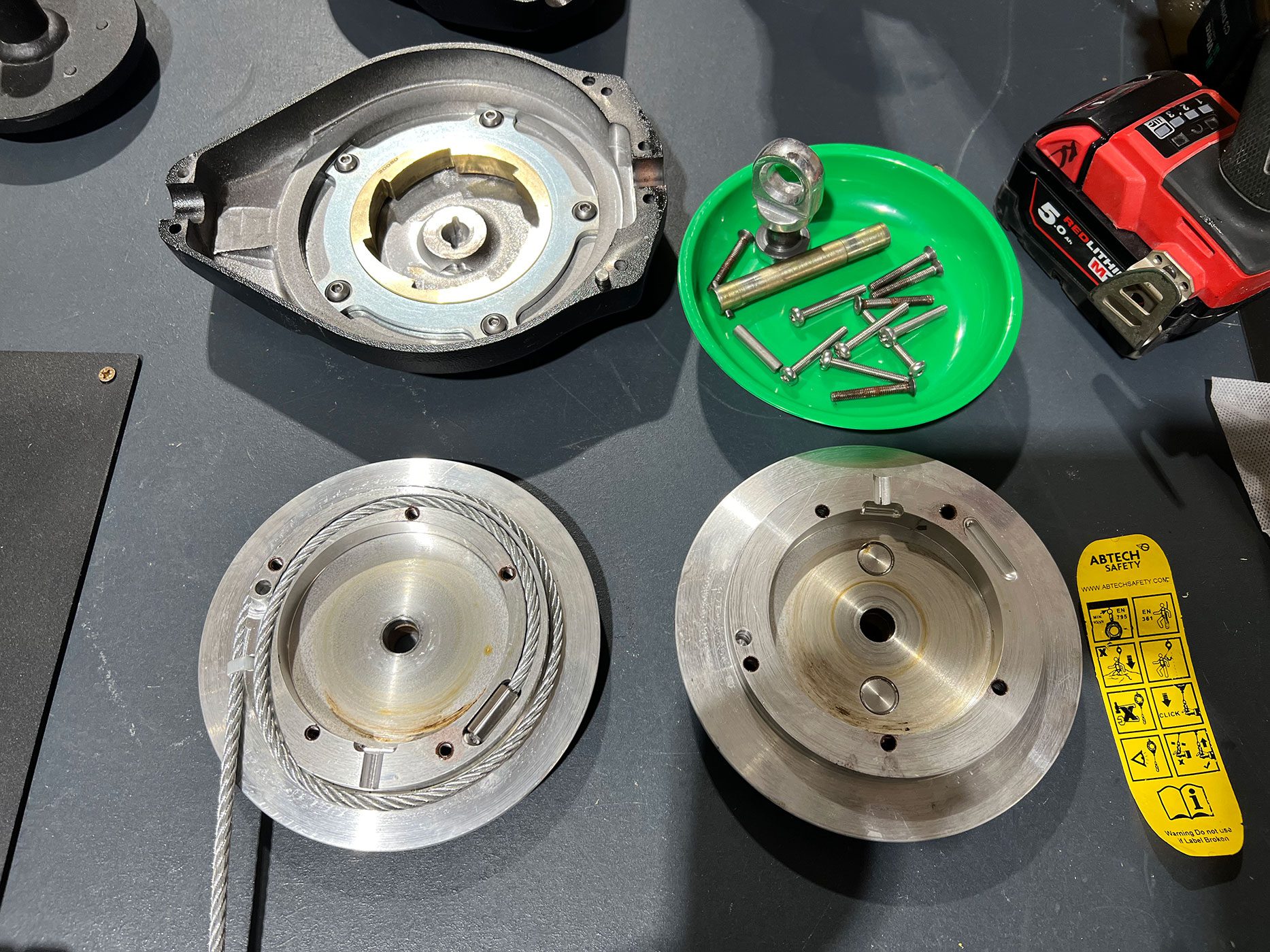
Mechanical equipment such as fall arrest blocks and inertia reels may be serviceable, but only when the manufacturer allows it and approved parts, procedures and competent servicing support are available.
As a broad guide:
- Harnesses and webbing lanyards: usually replaced if serious defects, missing labels or deployed shock absorbers are found.
- Fall arrest blocks and inertia reels: may be serviceable if supported by the manufacturer and inspected by an approved provider.
- Anchor devices and fixed systems: may require inspection, testing, documentation review or remedial works depending on the issue.
This distinction matters because “failed inspection” does not always lead to the same outcome. Some equipment is designed to be replaced. Some can be serviced. Some could be repaired in theory but cannot be recertified because the support route is missing.
Why Manufacturer Support Matters
One of the most overlooked questions when buying fall arrest equipment is:
“Who will service this in five years?”
Many buyers focus entirely on the purchase price.
The long-term support network is often ignored.
Before buying any fall arrest equipment, it is worth understanding:
- Whether approved service centres exist in the UK.
- Whether spare parts are available.
- How servicing and recertification are carried out.
- How long the manufacturer supports the product.
- What happens if a critical component fails inspection.
The answers to these questions often determine the true lifetime cost of ownership.
Questions to Ask Before Buying Fall Arrest Equipment
If you are comparing products, ask these questions before making a decision:
- Can the equipment be serviced in the UK?
- Are spare parts readily available?
- Is there an approved repair network?
- Will the manufacturer still support the product in the future?
- Can the equipment be recertified after inspection?
- Who carries out warranty repairs?
- What happens if the equipment fails inspection?
These questions are often more important than a small difference in purchase price.
The Hidden Cost of Cheap Fall Arrest Equipment
The cheapest option at purchase is not always the cheapest option over the life of the equipment.
We have seen situations where businesses purchased equipment because the initial cost looked attractive, only to discover later that servicing support was limited, spare parts could not be sourced, or recertification was not possible.
A relatively small saving at the point of purchase can become a much larger replacement cost if equipment cannot be repaired when defects are identified.
This is why many organisations now consider:
- Inspection requirements
- Servicing support
- Repair availability
- Recertification routes
- Manufacturer backing
alongside the initial purchase price.
Can Fall Arrest Blocks Be Serviced?
Many fall arrest blocks, inertia reels and other PFPE products can be serviced and recertified when supported by approved manufacturers and service centres.
However, not every product on the market offers this option.
Before assuming a fall arrest block can be repaired, it is important to confirm:
- Whether servicing is permitted.
- Whether approved spare parts exist.
- Whether inspection failures can be rectified.
- Whether recertification is available after repair.
Velocity Safety provides fall arrest block and inertia reel servicing, PFPE inspections and fall arrest anchor inspection and testing for supported equipment and systems.
What Should You Do If Your Equipment Has Failed Inspection?
If fall arrest equipment has failed inspection, avoid assuming replacement is the only option.
Start by gathering:
- The inspection report.
- Manufacturer details.
- Model and serial numbers.
- Previous servicing records.
- Any available technical documentation.
A competent provider can then determine whether the equipment can be repaired, serviced, recertified or whether replacement is the safest option.
Need Help With Failed Fall Arrest Equipment?
Velocity Safety provides PFPE inspections, fall arrest block and inertia reel servicing, and support for approved working-at-height equipment across the UK.
📞 Call: 01254 933 486
📩 Email: info@velocitysafety.co.uk
🌐 Request a Quote
FAQs
Here are answers to some of the most common questions we hear from businesses whose fall arrest equipment has failed inspection, cannot be repaired, or is no longer supported by the original manufacturer.
Does a failed inspection automatically mean fall arrest equipment must be replaced?
Not always. Some defects can be repaired or rectified through approved servicing routes. The outcome depends on the type of equipment, the defect and the availability of manufacturer support.
Can fall arrest blocks be repaired?
Many can, provided approved spare parts and servicing support are available. However, some products cannot be repaired or recertified once defects are identified.
Why can’t some fall arrest equipment be serviced?
Common reasons include discontinued products, lack of spare parts, no approved repair centres, missing technical documentation or manufacturer restrictions on repairs.
How often should fall arrest equipment be inspected?
Inspection frequency depends on the equipment type, manufacturer guidance and working environment. Employers should ensure inspections are carried out by competent persons in accordance with relevant requirements.
What should I check before buying fall arrest equipment?
Check servicing availability, spare parts support, repair options, recertification routes, manufacturer backing and long-term support arrangements, not just the purchase price.
What fall arrest equipment should be removed from service?
Fall arrest equipment should be removed from service if it has arrested a fall, failed inspection, has damaged webbing or stitching, deployed shock absorbers, corrosion, missing labels, expired service life or any defect that could affect safe performance. A competent person should assess whether it can be repaired, serviced, recertified or permanently withdrawn.
Can Velocity Safety inspect and service fall arrest equipment?
Yes. Velocity Safety provides PFPE inspections, fall arrest block servicing and support for approved working-at-height equipment across the UK.