A worn-looking fall arrest block is worth assessing before you decide whether to replace it. Refurbishment may offer a way to keep suitable equipment in service, but the decision depends on its condition, manufacturer support and the work required.
Can fall arrest block refurbishment save money?
Yes, where the model remains supported, the required repairs are permitted and the total cost makes sense compared with a suitable replacement. Savings depend on the individual unit. Refurbishment must meet the manufacturer’s requirements and cannot override a retirement limit or make an unsupported model serviceable.
Globestock G-Saver II: Before and After
This workshop example, shared by Velocity Safety’s Ross Ciraolo, shows a blue Globestock G-Saver II SRL-R before and after refurbishment.
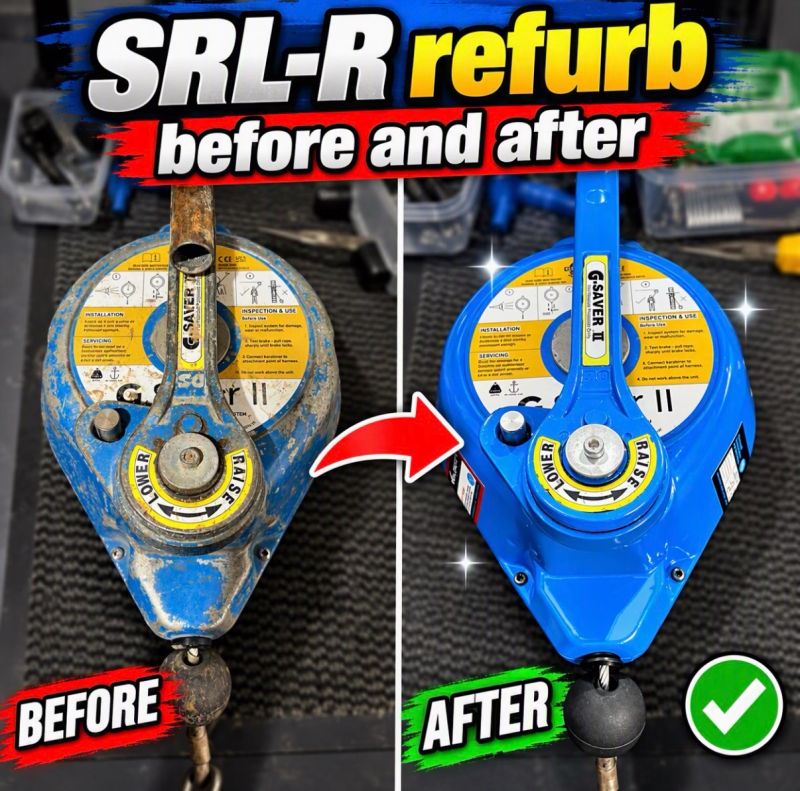
The photograph shows the visible restoration. The service record is what confirms the internal work, replacement components and testing completed on a particular block.
Internal work from an earlier workshop job
In a separate, earlier G-Saver II job, we replaced components including the rope, pawl springs, brake discs, ratchet centres and main spring following strip-down and internal examination. That parts list relates to the earlier job; the scope of any refurbishment depends on the equipment and its manufacturer’s procedure.
We also have a separate Ridgegear winch refurbishment case study showing work on a different type of equipment.
Should You Refurbish or Replace a Fall Arrest Block?
Start with whether the equipment can be supported safely. A useful assessment should address these four points before you compare costs.
| What to check | Why it affects the decision |
|---|---|
| Exact model and manufacturer support | Confirm the make, model and serial number. Similar-looking blocks can have different service requirements, and older versions may no longer be supported. |
| Condition and history | Damage, corrosion, contamination, previous repairs and any fall arrest event can affect the permitted next steps. Provide the available history for assessment. |
| Approved parts and repair procedure | The necessary components and an applicable manufacturer-approved repair route must be available. Some models are not designed to be repaired. |
| Service-life or retirement limits | Check any limits set by the manufacturer. A service or cosmetic restoration does not automatically reset the equipment’s age or extend those limits. |
Own an older Globestock G-Saver II? Globestock ended support for the older 414-02 series from 1 January 2025. Check the exact model and serial number against the manufacturer’s servicing notice before assuming a unit is eligible for refurbishment.
How to Compare Refurbishment and Replacement Costs
Once a viable repair route has been established, compare the complete refurbishment quotation with a suitable replacement for the same intended use.
- Scope of work: check which examination, servicing, replacement parts, testing and records are included.
- Total cost: include any applicable transport or assessment charges when comparing options.
- Availability: confirm the expected timescale for each option and whether temporary equipment will be needed.
- Future support: consider the model’s remaining manufacturer support and any applicable service-life limits.
Refurbishment can avoid an unnecessary replacement purchase where a supported block can be restored appropriately. If essential parts are unavailable, repairs are not permitted or the quotation approaches the cost of a suitable new unit, replacement may be the more practical option.
What Can Refurbishment Include?
Depending on the model and assessment findings, the work may include:
- Strip-down, cleaning and examination of internal components.
- Replacement of worn parts and components specified by the service procedure.
- Reassembly, lubrication where specified, and the required testing.
- Renewal of labels or external finishes where appropriate, with records of the work completed.
The technician needs the competence, procedures, tooling and any manufacturer authorisation required for that equipment. HSE’s maintenance guidance emphasises competent maintenance and the use of manufacturer’s instructions.
For the different roles of routine checks, periodic examination and servicing, read Do Fall Arrest Blocks Need Servicing or Just Inspection?
Find Out Whether Your Block Can Be Refurbished
Send Velocity Safety the make, model and serial number, photographs of the unit and its label, and any available inspection or service history. Include the number of units and any known damage or faults.
We can confirm whether we can support the equipment and discuss the appropriate assessment or servicing route.
Enquire about fall arrest block servicing and refurbishment
Call 01254 933 486 or email info@velocitysafety.co.uk.
Frequently Asked Questions
Can every fall arrest block be refurbished?
No. Suitability depends on the exact model, condition, manufacturer support, permitted repairs, parts availability and any retirement limits. Some models are not designed to be repaired.
Is refurbishment always cheaper than replacement?
No. The work required varies between units. Compare the full refurbishment quotation with a suitable replacement, taking account of any transport or assessment charges and the expected timescale.
Does refurbishment give a fall arrest block a new service life?
It does not automatically reset its age or override a manufacturer’s retirement limit. Continued use must follow the applicable manufacturer’s requirements and the outcome of the assessment, work and testing.