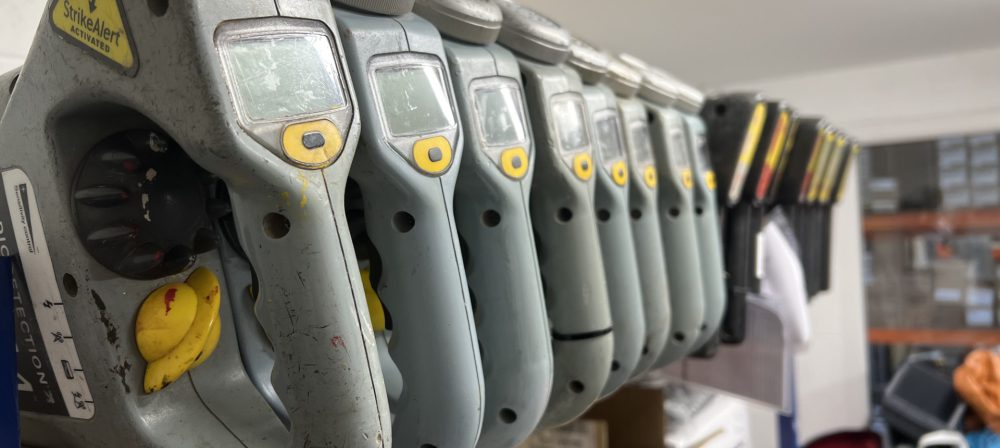
CAT & Genny calibration keeps your detection equipment accurate, compliant, and ready to prevent costly underground strikes.
Used every day across construction, utilities, and civil engineering, the Cable Avoidance Tool (CAT) and Signal Generator (Genny) are vital for locating buried services before excavation.
But without proper calibration, even a working unit can give false confidence – and false readings.
This guide explains how CAT & Genny systems work, why regular calibration is required under PUWER and HSG47, and what’s involved to stay compliant and protect your workforce.
Quick Answer: What is a CAT & Genny?
A CAT and Genny is a cable avoidance system used to locate buried services before digging. CAT stands for Cable Avoidance Tool, while Genny is the commonly used name for the Signal Generator. The CAT detects electromagnetic signals associated with underground cables and metallic services, while the Genny applies a traceable signal to help the operator locate a particular service more accurately.
Key Takeaways
- CAT & Genny tools locate underground cables and pipes before excavation.
- Annual calibration is strongly recommended to maintain PUWER compliance and ensure ongoing accuracy.
- Accurate calibration prevents service strikes, downtime, and insurance issues.
🧭 Jump to:
What is a CAT & Genny?
The Cable Avoidance Tool (CAT) and Signal Generator (Genny) are used to detect buried infrastructure like:
- Electrical cables
- Water and gas mains
- Fibre-optic and telecom lines
The CAT can search for naturally occurring or deliberately applied electromagnetic signals using several detection modes. Operators should normally use more than one mode because each mode identifies different types of signal and has different limitations.
The main Power, Radio and Genny modes are explained in more detail below.
How Does a CAT & Genny Work?
A CAT detects electromagnetic signals associated with underground cables and metallic services. Some signals are produced naturally by live electrical cables or re-radiated radio signals, while others are deliberately applied using the Genny.
The Genny can apply a signal to a service in several ways:
- Direct connection: The Genny is physically connected to an accessible metallic service, allowing the signal to travel along it.
- Signal clamp: A clamp is placed around an accessible cable or pipe to apply the signal without making a direct electrical connection.
- Induction: The Genny is placed above the suspected route and broadcasts a signal into nearby conductive services.
- Sonde or traceable rod: A small transmitter or traceable accessory is introduced into a duct, drain or pipe so its route can be followed.
The CAT is then used to detect and trace the applied or naturally occurring signal from the surface.
What Are the CAT & Genny Modes?
CAT scanners use different modes to search for different types of electromagnetic signal. The exact names and features vary between manufacturers, but most units include Power, Radio and Genny modes.
| Mode | What It Detects | Main Limitation |
|---|---|---|
| Power Mode | Electromagnetic fields produced by loaded or live electrical cables. | A cable may not be detected if it is not carrying sufficient current or if the signal is weak. |
| Radio Mode | Long-wave radio signals that are picked up and re-radiated by buried metallic services. | Not every metallic service will carry a detectable radio signal. |
| Genny Mode | A specific signal deliberately applied to a service using the signal generator. | The signal may transfer onto neighbouring services if the setup or separation is poor. |
| AllScan, Avoidance or Auto Mode | A broader search across multiple frequencies or detection methods, depending on the model. | This is manufacturer-specific and should not replace systematic scanning in the individual modes. |
A reliable survey should not normally depend on one mode alone. Operators should sweep the area systematically using the available passive modes before applying the Genny signal to trace particular services more accurately.
How to Use a CAT & Genny
CAT & Genny equipment should be used by someone who has received suitable instruction and understands both the equipment and its limitations.
A typical scanning process includes:
- Review service information: Check current utility plans, previous survey information and visible site features before starting the scan.
- Complete pre-use checks: Inspect the CAT, Genny, leads and accessories for damage. Confirm the batteries are charged, the self-test completes correctly and the calibration or inspection status is current.
- Survey the area visually: Look for inspection covers, meter boxes, service entries, street furniture, patched surfaces and other signs of underground services.
- Scan in Power Mode: Sweep the full work area systematically to search for signals from loaded electrical cables.
- Repeat in Radio Mode: Rescan the same area to identify metallic services carrying re-radiated radio signals.
- Apply the Genny signal: Use direct connection, a clamp, induction or a suitable accessory to apply a signal to the service being traced.
- Trace the complete route: Follow the detected signal beyond the immediate excavation area rather than marking only a single point.
- Cross-check the reading: Scan from different directions and at right angles to the suspected service route.
- Mark the findings: Clearly mark the likely position and route of each detected service using an agreed site system.
- Confirm through safe excavation: Use appropriate safe digging techniques and trial holes where required. Detection equipment should support, not replace, safe excavation controls.
Important: Does a clear CAT scan mean it is safe to dig?
No. A CAT & Genny cannot guarantee that the ground is free from underground services. Results should be considered alongside service plans, site observations, operator competence and safe excavation methods.
HSG47 provides further guidance on planning, locating services and carrying out excavation safely.
Can a CAT & Genny Detect Water Pipes?
A CAT and Genny can detect some underground water pipes, but detectability depends on the pipe material and whether a traceable signal can be applied.
- Metallic water pipes: These can often be detected if they carry a suitable passive signal or if the Genny signal can be applied directly or using a clamp.
- Plastic pipes with tracer wire: The tracer wire may be energised using the Genny and followed using the CAT.
- Plastic pipes without tracer wire: These cannot normally be detected directly because plastic does not conduct an electromagnetic signal.
- Accessible plastic pipes, ducts or drains: A sonde, Flexitrace or traceable rod may be inserted so the route can be followed from the surface.
The absence of a reading does not prove that no water pipe is present. Older plans, missing tracer wires, inaccessible entry points and non-conductive materials can all limit detection.
What mode should you use to find a water pipe?
For a metallic water pipe, Genny Mode will often provide the clearest result where a signal can be applied directly or through a clamp. Power Mode is generally associated with live electrical cables, while Radio Mode may detect some metallic pipes if they are carrying re-radiated radio signals.
Plastic water pipes require a tracer wire, sonde, Flexitrace or another traceable accessory. Changing the CAT mode alone will not make an untraceable plastic pipe detectable.
Why Calibration Matters
Daily use, impacts, vibration, water ingress, damaged antennas, ageing components and battery issues can all affect the sensitivity or reliability of a CAT & Genny.
A unit may power on and complete its basic self-test while still producing readings that fall outside the expected tolerances.
If the equipment has not been checked and calibrated appropriately:
- Underground services may be missed or incorrectly traced.
- False or unstable readings may cause unnecessary excavation delays.
- The employer may be unable to demonstrate that the equipment was properly maintained.
- An equipment fault may contribute to a cable or service strike.
HSG47 says locating devices should be kept in good working order and checked and calibrated regularly. PUWER also requires work equipment to be maintained in an efficient state, in efficient working order and in good repair.
Calibration provides traceable evidence that the equipment has been tested against controlled reference signals and was operating within the required tolerances at the time of the test.
📋 Book a CAT & Genny Calibration with Confidence
Unsure if your detection kit is still accurate? Velocity Safety provides traceable CAT & Genny calibration across the UK – helping you stay compliant with PUWER and HSG47 while keeping your workforce safe.
- ✔️ On-site or workshop calibration
- ✔️ 12-month certificate included
- ✔️ Same-day turnaround available
- ✔️ Fully traceable results and compliance reporting
How Often Should a CAT & Genny Be Calibrated?
Many CAT & Genny units are placed on a 12-month calibration cycle, but the correct interval should be based on the manufacturer’s instructions, the frequency of use, the working environment and the condition of the equipment.
Calibration or further testing may be required sooner where the equipment has:
- Been dropped or suffered a significant impact.
- Been exposed to water, excessive moisture or contamination.
- Started producing inconsistent, weak or unexpected readings.
- Failed a self-test or pre-use check.
- Been repaired or had components replaced.
- Been used intensively in harsh site conditions.
For high-use equipment, employers may also introduce interim functional checks between formal calibration dates.
🛠️ What do PUWER and HSG47 require?
- PUWER requires work equipment to be maintained in an efficient state, in efficient working order and in good repair.
- HSG47 says service-locating equipment should be maintained, regularly checked and calibrated.
- The manufacturer’s inspection, functional-check and calibration instructions should also be followed.
A recorded calibration programme helps demonstrate that these responsibilities are being managed.
What’s Involved in Calibration?
A full CAT & Genny calibration typically includes:
- Visual inspection: The housing, controls, display, antenna, battery compartment, leads and accessories are checked for damage or contamination.
- Functional testing: The controls, speaker, display, sensitivity adjustment and self-test functions are checked.
- Power Mode testing: The CAT is tested against controlled signals representing detectable electrical services.
- Radio Mode testing: The unit’s response to appropriate radio-frequency reference signals is checked.
- Genny Mode testing: The CAT and signal generator are tested across the relevant frequencies and operating methods.
- Accuracy and sensitivity checks: Results are compared with traceable reference equipment and the manufacturer’s permitted tolerances.
- Adjustment or realignment: Where the model allows, readings outside tolerance are adjusted before the equipment is tested again.
- Final pass or fail decision: Equipment is only returned to service once it has completed the required checks successfully.
- Calibration record: A certificate is issued identifying the equipment, serial number, calibration date, results and next recommended due date.
Depending on the model and its condition, calibration may also identify the need for repairs, replacement leads, battery contacts, housings, firmware updates or other corrective work.
At Velocity Safety, CAT & Genny calibration can be completed on-site or through the workshop service, with traceable certification supplied for each unit.
Do CAT Scanners Need Calibration?
Yes. CAT scanners should be checked and calibrated at appropriate intervals to confirm that their detection modes, sensitivity and operating functions remain within the required tolerances.
A basic self-test or successful power-on check does not provide the same assurance as calibration against controlled reference signals.
Equipment that has not been properly maintained or calibrated may:
- Miss services that should have produced a detectable signal.
- Produce weak, unstable or misleading readings.
- Fail to apply or detect the correct Genny frequencies.
- Leave the employer without adequate maintenance and calibration records.
An overdue calibration date does not automatically prove that a unit is inaccurate, but it does mean there may be insufficient current evidence that the equipment remains reliable. The unit should be assessed before it is relied upon for excavation work.
What the HSE and Manufacturers Say
HSG47 explains that service-locating equipment should be maintained in good working order and regularly checked and calibrated. It also emphasises that operators must understand how to use the equipment and recognise its limitations.
Manufacturers publish model-specific instructions covering:
- Pre-use and self-test procedures.
- Recommended calibration or service intervals.
- Checks required after impact, water exposure or suspected faults.
- Permitted operating tolerances.
- Compatible transmitters, clamps, sondes and accessories.
The manufacturer’s instructions should therefore be used alongside the employer’s PUWER maintenance programme and the safe-working principles set out in HSG47.
Neglecting checks, calibration or known defects may become significant if inaccurate equipment contributes to a service strike, injury or project disruption.
On-Site vs Off-Site Calibration Options
Velocity Safety provides flexible options:
| Option | Benefits |
|---|---|
| On-Site Calibration | ✔️ No downtime, ✔️ Fast turnaround, ✔️ Nationwide coverage |
| Workshop Calibration (Blackburn) | ✔️ Full diagnostics, ✔️ Access to spares, ✔️ Ideal for bulk servicing |
Additional services:
- Equipment sales and refurbs
- Repairs and servicing
- Operator training and technical support
Want More Details on Calibration Options?
Learn more about Velocity Safety’s CAT & Genny Calibration Services – including on-site and workshop options, collection services, and same-day turnaround where available.
- ✔️ Nationwide collection available
- ✔️ Full calibration to manufacturer spec
- ✔️ Certificate included – valid for 12 months
- ✔️ Same-day turnaround on request
📞 Call: 01254 933 486
📩 Email: info@velocitysafety.co.uk
🌐 Or visit: our CAT & Genny Calibration page to request a quote or collection.
FAQs
Here are the most common questions about CAT and Genny use, calibration, certificates, detection limits and HSG47 compliance.
What is a CAT & Genny?
A CAT and Genny is a cable avoidance system used to help locate underground services before excavation. The CAT detects electromagnetic signals, while the Genny applies a traceable signal to cables, metallic pipes or suitable tracing accessories.
What does CAT and Genny stand for?
CAT stands for Cable Avoidance Tool. Genny is the commonly used shortened name for the Signal Generator used alongside the CAT.
How does a CAT & Genny work?
The CAT detects electromagnetic signals associated with buried cables and metallic services. The Genny applies a controlled signal through direct connection, a clamp or induction, allowing the CAT operator to trace a particular service more accurately.
What are the CAT & Genny modes?
Power Mode searches for signals produced by loaded electrical cables. Radio Mode detects re-radiated radio signals carried by some metallic services. Genny Mode detects a signal deliberately applied using the signal generator. Some models also include manufacturer-specific AllScan, Avoidance or Auto modes.
How do you use a CAT & Genny safely?
Review available service plans, inspect the equipment, scan the full area systematically in the available passive modes, apply the Genny signal where appropriate, trace each detected service from more than one direction and clearly mark the results. The findings should then be combined with safe excavation techniques rather than treated as proof that the ground is clear.
Can you use a CAT without a Genny?
A CAT can be used in passive Power and Radio modes without a Genny. However, passive signals are not always present or detectable. Using the Genny allows a specific signal to be applied and usually provides a more reliable way to trace suitable services.
Can a CAT & Genny detect water pipes?
It can detect metallic water pipes where a suitable signal is present or can be applied. Plastic pipes generally cannot be detected directly unless they include a tracer wire or can be traced using a sonde, Flexitrace or another suitable accessory.
What mode should you use to find a water pipe?
Genny Mode is generally the most useful option for tracing a metallic water pipe where the signal can be applied directly or using a clamp. Radio Mode may detect some metallic pipes carrying re-radiated signals. Plastic pipes require a tracer wire or traceable accessory rather than a different CAT mode.
Can a CAT & Genny detect every underground service?
No. Detection depends on the service material, signal strength, depth, surrounding ground conditions, nearby services and the equipment used. Non-conductive pipes, unenergised cables and poorly positioned services may not produce a detectable signal.
Does a CAT & Genny replace utility plans?
No. Service plans and CAT & Genny scanning should be used together. Plans can be incomplete or inaccurate, while detection equipment also has limitations. Neither should be relied upon as the sole control before excavation.
Does a CAT & Genny show the exact depth of a service?
Some compatible CAT and Genny systems can estimate depth when the correct active signal and operating method are used. The result is an estimate rather than a guarantee and can be affected by signal distortion, neighbouring services and incorrect technique.
How often should a CAT & Genny be calibrated?
Many units are placed on a 12-month calibration cycle, but the correct interval depends on the manufacturer’s instructions, equipment condition, frequency of use and working environment. The unit should also be checked after impact, water ingress, repair or unreliable readings.
Is CAT & Genny calibration legally required?
UK legislation does not set one universal calibration interval for every CAT & Genny. However, PUWER requires work equipment to be properly maintained, and HSG47 says locating equipment should be regularly checked and calibrated. Employers should follow the manufacturer’s instructions and maintain appropriate records.
What does CAT & Genny calibration test?
Calibration checks the relevant detection modes, frequencies, sensitivity, controls, display, speaker and transmitter functions against controlled reference signals. Where permitted, equipment outside tolerance is adjusted and retested before it is passed.
What happens if a CAT & Genny fails calibration?
The equipment should not be returned to normal use until the fault has been investigated. Depending on the issue, it may require adjustment, repair, replacement components or replacement of the unit.
How long does a CAT & Genny calibration certificate last?
A calibration certificate records the equipment’s condition and test results on the date of calibration. Many providers also state a recommended next due date, commonly 12 months later. The unit should still be assessed sooner if it is damaged, exposed to water or begins producing unreliable readings.
What should a CAT & Genny calibration certificate include?
The certificate should normally identify the equipment make, model and serial number, the calibration date, the tests completed, the results, any adjustments made, the organisation or engineer completing the work and the recommended next calibration date.
Can you calibrate a CAT & Genny on-site?
Yes. Velocity Safety offers on-site CAT & Genny calibration for businesses that need to reduce equipment downtime, as well as workshop calibration for units requiring further diagnostics, servicing or repair.